

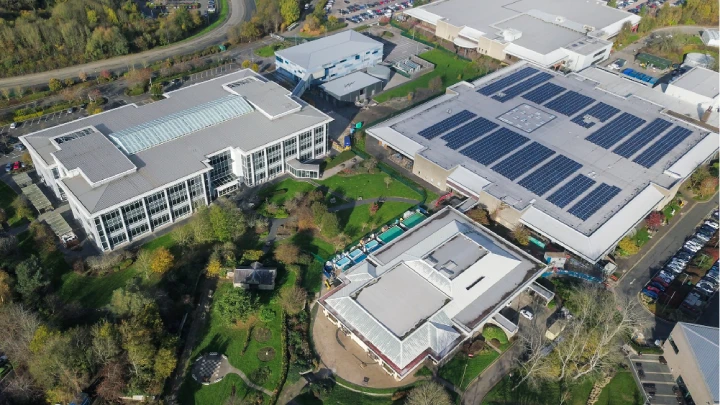
With the rise of digitization, cloud computing, Big Data, AI, 5G networks, fintech, streaming platforms, and e-commerce industries are all driving a massive surge in data usage. At the core of this evolution lies a powerful global engine: data centre.
In 2025, data centres are not just technology hubs — they have become major energy consumers. With thousands of servers running 24/7, cooling systems operating continuously, and high-performance hardware supporting millions of transactions and queries every second, data centres now demand unprecedented levels of power.
This growing energy appetite has pushed the industry to find reliable, scalable, and cost-efficient energy solutions. And the one answer emerging globally is solar power.
Today, the demand of solar for data centres is directly fuelling a new era of clean energy adoption. Let’s explore why — and what this means for industries, governments, and the clean-energy future.
Why Solar for Data Centres is Crucial Now?
1. Massive and Growing Energy Demand
Data centres are among the largest industrial electricity consumers in the world.
- AI training and cloud computing workloads are multiplying.
- Digital transformation is accelerating in finance, healthcare, education, and e-commerce.
- Real-time video streaming and IoT devices are increasing bandwidth requirements.
As computing power scales, energy consumption rises. Many modern data campuses now require hundreds of megawatts — equivalent to powering whole cities. Solar panels for commercial buildings offer a scalable solution that supports this expansion sustainably.
2. ESG & Net-Zero Commitments
Tech giants and hyperscale data operators — including Google, Amazon, Meta, and Microsoft — have adopted aggressive Net-Zero and renewable energy targets. Solar energy projects help them meet:
- ESG (Environmental, Social, Governance) commitments
- Carbon neutrality goals
- Green-data compliance standards
In 2025, companies that fail to decarbonize not only face rising energy costs, but also reputational risk and investor pressure. Solar energy offers cost savings and a go green advantage.
3. Lower Energy Costs & Long-Term Savings
Grid electricity prices continue to fluctuate, while solar tariffs have stabilised and declined. For hyperscale and edge-data operators, solar provides:
- Predictable power pricing.
- Lower cost per kWh over project life cycles.
- Reduced dependence on unstable grid supply.
- Long-term financial security.
Pairing solar with battery storage further ensures round-the-clock power availability, a crucial advantage for mission-critical data workloads.
4. Renewable Energy Certificates & Policy Support
Governments across the world — including India, UAE, EU, and the US — are introducing renewable energy incentives, tax benefits, and green-power procurement policies.
Solar for data centres can purchase power via:
- Captive solar plants
- Open access solar supply
- Solar PPAs (Power Purchase Agreements)
- On-site rooftop + ground-mounted solar
- Corporate renewable energy procurement programs
This flexibility makes solar for government projects integration easier and more financially viable than ever before.
Solar for Data Centres = A Powerful Energy Future
Solar energy is evolving to meet data centre needs. Today’s solar solutions offer:
✅ High-efficiency PV modules
✅ Bifacial solar panel technology
✅ Advanced solar trackers
✅ Energy storage & hybrid solutions
✅ Smart grid integration
Solar panels for commercial buildings can support large-scale, 24/7 digital operations — not just daytime demand.
Real-World Examples
Around the world, major players are already adopting solar for data infrastructure:
- Tech giants are building multi-GW renewable energy farms
- Solar-powered AI and cloud parks are emerging in Asia and the Middle East
- Hyperscale facilities are using solar + battery for power reliability
- Governments are approving renewable-energy data-park corridors
Solar for government projects isn’t a distant vision — it is happening now, and rapidly growing in 2025.
What This Means for India?
India is emerging as a global data-centre hub, supported by:
- Digital India growth
- Favourable renewable power policies
- Huge solar energy capacity expansion
- International tech investments in cloud and AI infrastructure
Data centres in Mumbai, Hyderabad, Bengaluru, Chennai, and Visakhapatnam are increasingly embracing solar for reliable, economical, and sustainable power supply.
For developers, EPC companies, and solar-tech providers, this represents a multi-billion-dollar opportunity.
The Road Ahead
As technology evolves, so does the need for clean energy. The rise of AI and high-performance computing accelerates energy demand — and solar stands at the forefront of the solution.
In 2025 and beyond, we will see:
- More solar-powered data campuses
- Growth in solar-storage hybrid systems
- Corporate renewable-energy power deals
- Stronger government renewable policies
- Increased investment in green digital infrastructure
Data centres and solar energy are now deeply interconnected. Their partnership is shaping a smarter, greener future — one where digital innovation and sustainability thrive together.
Final Thought
The world’s data needs will only expand, and so will the need for clean energy. As big electricity users migrate to solar, the data revolution will be powered by the sun.
Businesses, governments, and energy providers that embrace this shift early will lead the digital-clean-energy era.
Like the read? Subscribe to our newsletter or write back to us at info@smrenergy.co.